_edited.png)
Passover Kitchen Design Ideas: Glass Enclosures vs. Alternative Screening Solutions
- Privlux Inc.
- 3 days ago
- 4 min read
One of the more overlooked aspects of Passover kitchen design ideas is not just how to clean a kitchen, but how to control it. Pesach introduces a temporary but highly structured way of using space—requiring separation, visibility, and efficient workflow all at once.
To achieve this, many homeowners explore enclosure solutions. Two commonly considered approaches are glass enclosures and fabric-based or retractable screening systems. Both serve a purpose, and both are used across residential and hospitality environments. The real question is not which is “better,” but which performs more effectively under the specific demands of Pesach.
This article takes a practical look at how these systems compare—focusing on hygiene, usability, durability, and long-term value—without dismissing the role either can play.

Understanding the Functional Demands of Pesach
Before comparing solutions, it is worth grounding the discussion in what Pesach actually requires from a kitchen environment:
Thorough cleaning of surfaces
Minimization of residue and particle retention
Clear separation between zones
Efficient movement between preparation, cooking, and serving
From a scientific standpoint, smooth and non-porous surfaces are generally easier to clean and sanitize because they do not trap particles or absorb moisture (U.S. FDA Food Code; WHO guidelines on food hygiene). This principle is widely applied in commercial kitchens and healthcare environments. However, Pesach is not a commercial setting—it is a lived-in space. That means flexibility, comfort, and practicality also matter.
Glass Enclosures: Stability, Visibility, and Surface Integrity
Glass enclosures are often considered in Passover kitchen design ideas because of their inherent material properties.
Key Strengths:
Non-porous surface: Glass does not absorb food particles, oils, or moisture, making it easier to clean thoroughly.
Rigid barrier: Provides a clearly defined and stable physical separation between areas.
Full visibility: Maintains line of sight across the kitchen, which supports supervision and coordination during preparation.
Light transmission: Does not block natural light, preserving the openness of the space.
These characteristics align closely with environments where hygiene and clarity are priorities.
Practical Considerations:
Glass systems are fixed or track-based, meaning installation requires planning.
While easy to wipe clean, they do require regular cleaning to maintain clarity (e.g., fingerprints, smudges).
Typically represent a more permanent design decision.

Alternative Screening Solutions: Flexibility and Adaptability
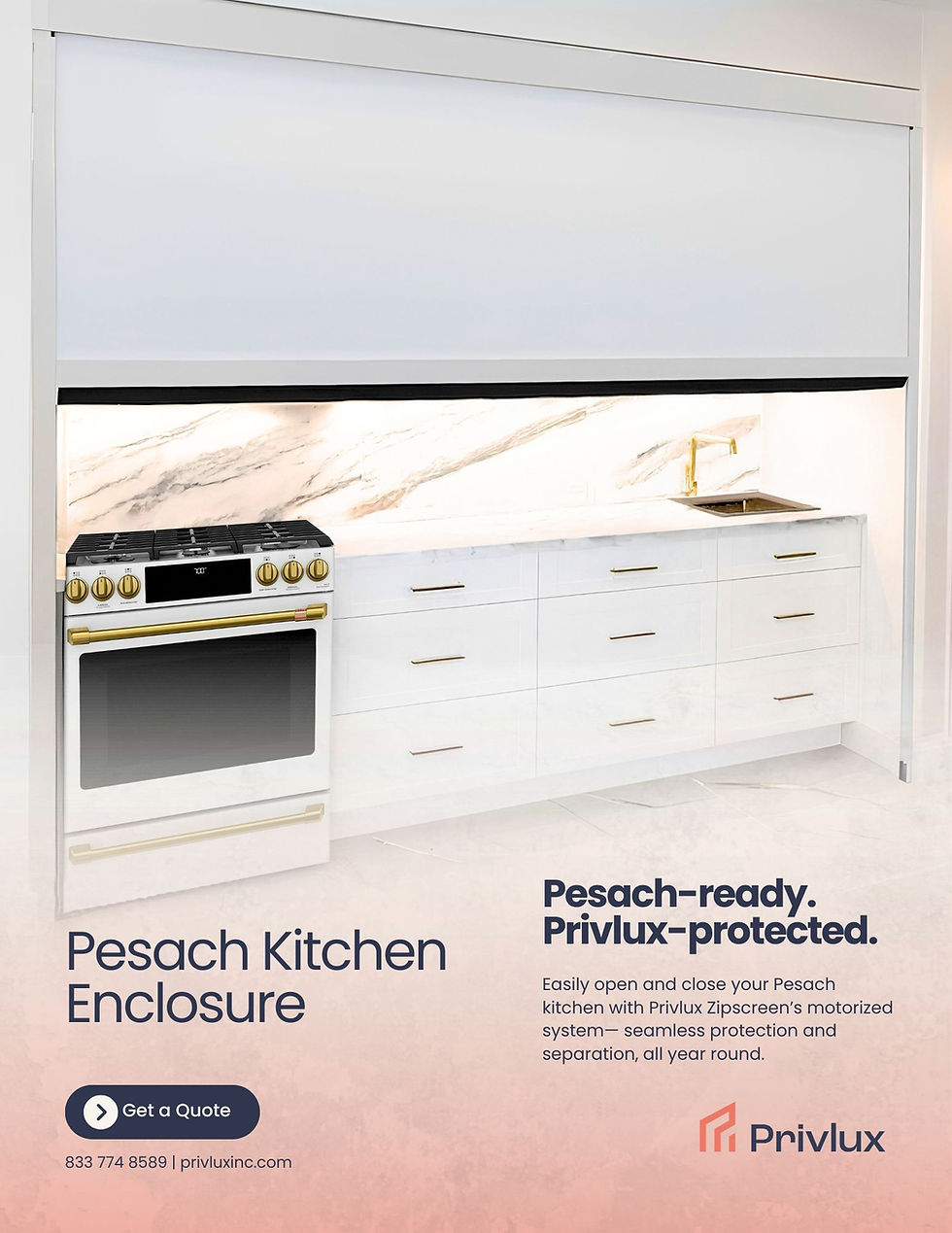
Fabric-based or retractable screening systems are also part of modern Passover kitchen design ideas, particularly in spaces where permanent installations are less feasible.
Key Strengths:
Retractable design: Can be deployed only when needed and hidden when not in use.
Lightweight operation: Easy to open, close, and adjust quickly.
Minimal structural impact: Often requires less invasive installation compared to glass systems.
Adaptable use cases: Can be used in kitchens, patios, or transitional spaces.
These features make screening solutions appealing for households that prioritize flexibility or temporary separation.
Practical Considerations:
Surface characteristics: Fabric or mesh materials are not typically non-porous, which may require more careful cleaning or maintenance.
Barrier strength: While effective for visual or spatial separation, they may not provide the same rigid containment as glass.
Longevity factors: Exposure to grease, moisture, and repeated cleaning can influence durability over time.
Performance Comparison in a Pesach Setting
When viewed through the lens of Passover kitchen design ideas, the comparison becomes less about preference and more about performance under specific conditions.
1. Cleaning and Hygiene Glass surfaces can be cleaned with standard non-abrasive solutions and do not retain residue. Screening materials may require more careful handling depending on their composition and exposure.
2. Separation Effectiveness Glass provides a firm, continuous barrier. Screening solutions offer separation but may allow more airflow or movement between spaces.
3. Flexibility Screening systems are typically more adaptable for temporary or occasional use. Glass systems, depending on type (sliding, folding), can also offer flexibility but within a more structured framework.
4. Visual and Spatial Impact Both solutions maintain openness in different ways. Glass preserves transparency, while screens maintain openness through lightness and minimal visual weight.
5. Long-Term Use Glass enclosures often function as a year-round architectural feature. Screening systems may serve multiple seasonal or situational purposes.
Design Perspective: It’s Not Either-Or
A growing trend in Passover kitchen design ideas is the integration of both systems within the same home.
For example:
Glass enclosures may define the primary kitchen boundary
Screening solutions may be used in adjacent or transitional spaces
This layered approach reflects how modern homes are designed—not for a single use case, but for multiple overlapping needs. Architecturally, this aligns with the concept of adaptive space design, where environments can shift function without requiring permanent structural change.
Economic and Practical Considerations
From an investment standpoint, the decision often comes down to:
Frequency of use: Is the enclosure needed only for Pesach, or year-round?
Level of control required: Does the space need firm separation or flexible division?
Maintenance expectations: How much ongoing care is acceptable?
Integration with existing design: Will the solution feel cohesive with the rest of the home?
There is no universal answer. A household that values permanence and durability may lean toward glass. One that prioritizes adaptability may find screening solutions more aligned with their needs.
Choosing the Most Effective Passover Kitchen Design Ideas
The most effective Passover kitchen design ideas are not defined by a single product or system, but by how well they respond to real-world use.
Glass enclosures offer stability, clarity, and ease of cleaning—qualities that align closely with the technical demands of Pesach. Screening solutions bring flexibility, adaptability, and minimal intrusion—qualities that suit dynamic living environments. Rather than viewing them in opposition, it is more useful to see them as complementary tools within a broader design strategy.
For homeowners, architects, and designers, the goal is not to choose a side—but to understand how each solution performs, and to apply that understanding to the specific needs of the space. If you’re evaluating options for your kitchen this Pesach, or looking to better understand what would work in your layout, you can reach out via WhatsApp at 833 774 8589 for practical guidance or a tailored quotation.


Comments