_edited.png)
Onsite vs Remote: How a Pergola Supplier in New Jersey Structures Teams to Deliver Better Projects
- Privlux Inc.
- 9 hours ago
- 2 min read

Why this comparison is often misunderstood
There’s a common assumption in construction and design industries:
Onsite teams are “real work”
Remote teams are “support work”
In reality, both are essential—and when structured correctly, they solve different parts of the same problem. As a pergola supplier in New Jersey, we’ve seen firsthand how projects improve when roles are clearly divided and properly connected.
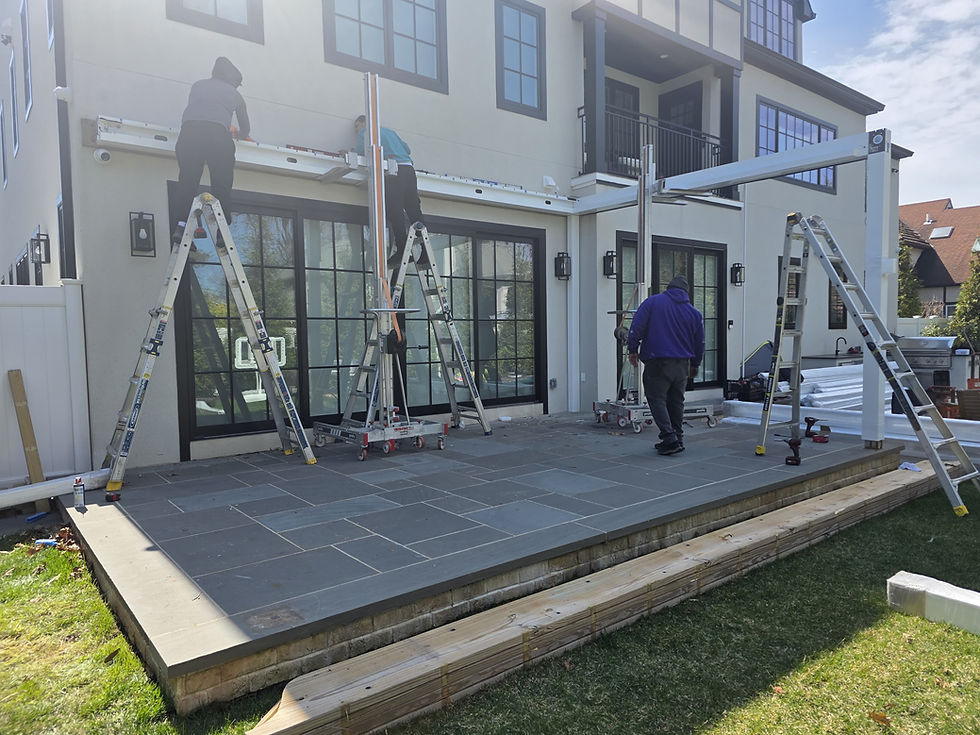
Onsite teams: execution in the physical environment
Onsite teams are responsible for what actually gets built.
Their role includes:
Site measurements
Structural installation of pergolas
Assembly of aluminum framing systems
Integration of sliding glass systems
Installation of zipscreens and vertical shades
Real-time adjustments during build phases
They operate where precision becomes physical reality.
This is where tolerances, alignment, and environmental conditions matter most.
Remote teams: coordination and continuity
Remote teams are often underestimated, but they are critical to consistency.
Their responsibilities include:
Project documentation
Design development and revisions
Client communication and updates
Scheduling and logistics coordination
Maintaining project history across all phases
They ensure that information does not reset every time someone changes context.
Why this structure matters
Most project issues don’t happen during execution.
They happen between stages.
For example:
A measurement is taken onsite but not fully documented
A client revision is communicated verbally but not recorded
A design change is not reflected in installation notes
This is where delays and misunderstandings occur.
The advantage of a hybrid structure
When onsite and remote teams are integrated properly:
1. Faster response times
Remote teams can address client queries without waiting for site availability.
2. Better tracking
Every decision is recorded and traceable, reducing confusion.
3. More consistent communication
Clients receive unified responses instead of fragmented updates.
Application across Privlux systems
This structure is especially important for complex systems we handle as a pergola supplier in New Jersey, including:
Bioclimatic aluminum pergolas
Sliding glass enclosure systems
Fixed pergola structures
Zipscreens and vertical shading systems
Each system requires coordination between design intent and physical execution.
Why systems matter more than individuals
It’s easy to assume service quality depends on individual skill.
But in reality, even skilled teams fail without structure.
Good systems:
Reduce dependency on memory
Standardize communication
Prevent information loss
Improve accountability
This is supported by lean construction principles, which emphasize that process design is a stronger predictor of performance than individual effort (Koskela, Lean Construction Theory).

Closing reflection from a Pergola Supplier in New Jersey
The goal is not to choose between onsite and remote.
The goal is to design a system where both work together without friction.
When that happens, projects become easier not because they are simpler—but because they are structured better. As a pergola supplier in New Jersey, this is the foundation we’ve built Privlux on: clarity, structure, and consistency across every phase of the project.
If you’re planning a pergola, sliding glass enclosure, or vertical shading system and want a clearer understanding of how the process works from design to installation, you can reach us on WhatsApp at 833 774 8589 for practical guidance or a quotation across all Privlux systems


Comments