_edited.png)
Why Good Service in Construction Isn’t About Location—It’s About Systems (Insights from a Pergola Supplier in New Jersey)
- Privlux Inc.
- 2 days ago
- 3 min read
A recent frustration that made me reflect
Not long ago, I had a call with a company that operates primarily with remote teams.
It didn’t go well.
The communication felt disorganized, context was missing, and every interaction felt like starting from zero. Notes weren’t carried over, and I kept getting inconsistent answers depending on who I was speaking to.
For a moment, I found myself thinking something unfair—but honest:
“Is this what people assume remote teams are like?”
That question stuck with me longer than the call itself.
Because after reviewing our own operations as a pergola supplier in New Jersey, I realized something important: The issue was never “remote vs onsite.”The issue was always systems vs lack of systems.
Where service actually breaks down
In construction and design-build environments, service failure is rarely caused by one person.
It usually comes from structural gaps in how information flows:
1. Poor documentation
When project details are not properly recorded, every conversation becomes isolated.
Research in operations management consistently shows that information loss between handoffs increases error rates and rework in service systems (see: Womack & Jones, Lean Thinking).
2. Lack of continuity
When clients speak to different people without a shared reference point, they are forced to repeat themselves.
This creates:
Frustration
Delays
Inconsistent decisions
3. Unclear ownership
When no one is fully responsible for a client or project thread, accountability becomes diluted.
Instead of one clear answer, clients receive multiple interpretations.
These are not “remote work problems.”
They are system design problems.
How Privlux structures service differently
As a pergola supplier in New Jersey, we learned early that service quality cannot rely on individual memory or informal communication.
We designed our system around structure.
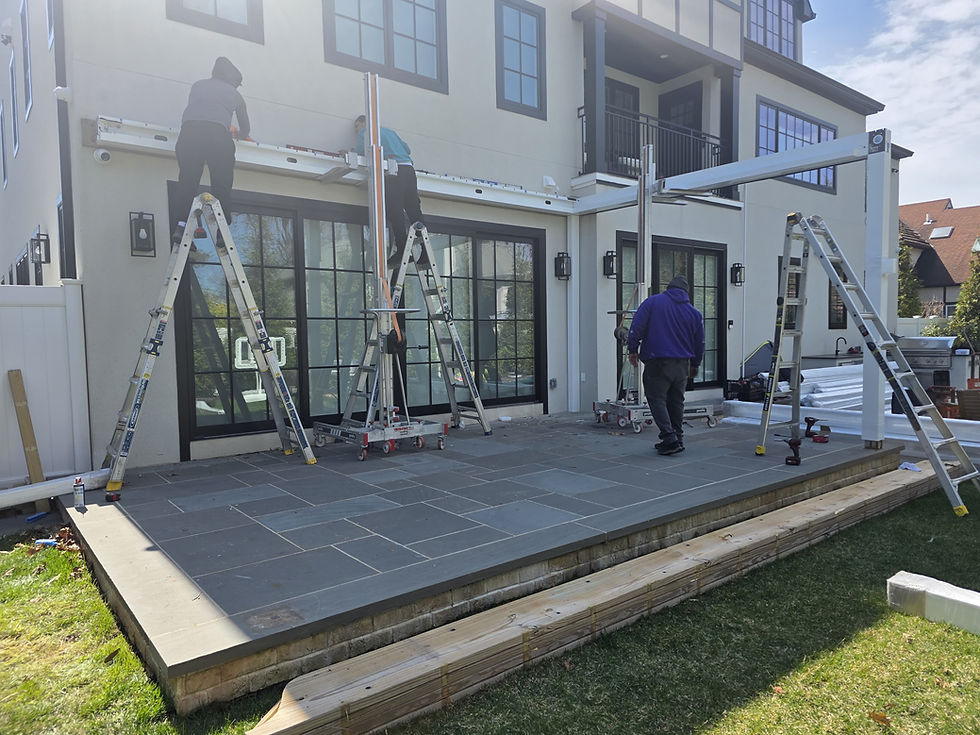
Onsite teams handle execution
Our onsite teams focus on:
Site measurements
Structural installation
Real-time adjustments
Physical coordination during build phases
They operate in the environment where decisions become physical outcomes.
Remote teams handle continuity
Our remote teams manage:
Design coordination
Client communication
Documentation and project history
Proposal updates and revisions
Follow-ups and scheduling
This ensures nothing is lost between site visits.

Why this combination matters
Construction projects fail when information is fragmented.
When onsite teams work alone, context is often lost after the site visit.When remote teams work alone, real-world constraints are sometimes misunderstood.
But when both are connected through structured systems:
Information stays consistent
Decisions are traceable
Clients don’t have to repeat themselves
Projects move with fewer delays
The role of consistency in service
What clients actually experience as “good service” is not speed alone.
It is consistency across touchpoints.
The first person they speak to
The person who prepares the design
The installer on site
The after-installation support
If those four are aligned, the experience feels seamless—even if the work behind it is complex.
If they are not aligned, even simple projects feel chaotic.
Closing thought: Insights from a Pergola Supplier in New Jersey
The more I work in this industry, the more I believe service quality has very little to do with geography. Onsite or remote is not the deciding factor. Systems are.
As a pergola supplier in New Jersey, this is something we’ve had to be intentional about—especially across projects involving pergolas, glass systems, sliding enclosures, and vertical shading solutions like zipscreens.
If you’re planning a project and want clarity on how these systems actually work in practice, you can reach us on WhatsApp at 833 774 8589 for straightforward advice or a quotation. We work across all Privlux systems including pergolas, sliding glass, and vertical shading solutions.


Comments