_edited.png)
Insights from a Trusted Pergola Glass Supplier in New Jersey: Why Non-Insulated Glass Works Better Than Most People Expect
- Privlux Inc.
- 2 hours ago
- 5 min read

There’s a common assumption in outdoor design that more insulation automatically means better performance.
In reality, it depends entirely on how the space is meant to function. As a trusted pergola glass supplier in New Jersey, we’ve seen many homeowners initially assume that any glass enclosure must behave like a fully conditioned interior room. But outdoor living spaces operate differently. In many projects, especially pergolas, patios, terraces, and semi-covered outdoor environments, the goal isn’t to completely isolate the outdoors—it’s to manage exposure while preserving openness.
That distinction matters more than most people realize. Over the past few years, non-insulated sliding glass systems have become increasingly relevant not because they imitate indoor construction, but because they support a different kind of outdoor experience: lighter, more flexible, and more connected to the surrounding environment.
In many cases, they work better than expected precisely because they are not trying to overcompensate.
The Misconception Around Outdoor Enclosures
One of the biggest misconceptions in outdoor architecture is the idea that every enclosure must prioritize maximum thermal separation. That thinking usually comes from interior construction standards, where insulation is essential for conditioned living areas. But pergolas and semi-outdoor spaces often serve a different purpose. These environments are designed to remain adaptable. They respond to changing weather conditions instead of resisting them entirely.
This is where non-insulated sliding glass becomes surprisingly practical. Rather than creating a fully sealed room, these systems provide protection from wind, rain, and debris while still allowing airflow, visibility, and openness when desired. The experience becomes less about isolation and more about environmental flexibility.
In climates like New Jersey, transitional seasons make this especially relevant. Spring and fall often bring moderate temperatures where complete enclosure can actually make a space feel heavier or disconnected from the outdoors. Operable, non-insulated systems allow homeowners to adjust the space naturally depending on the day.
Why Simplicity Often Performs Better
As a trusted pergola glass supplier in New Jersey, one thing we’ve consistently observed is that simpler systems often create more usable outdoor environments.
Heavy insulated systems certainly have their place—particularly in fully conditioned sunrooms or enclosed living spaces—but they also come with trade-offs:
Larger framing profiles
Increased structural load
Higher costs
Reduced openness
Less natural airflow
Non-insulated sliding glass systems avoid many of these compromises.
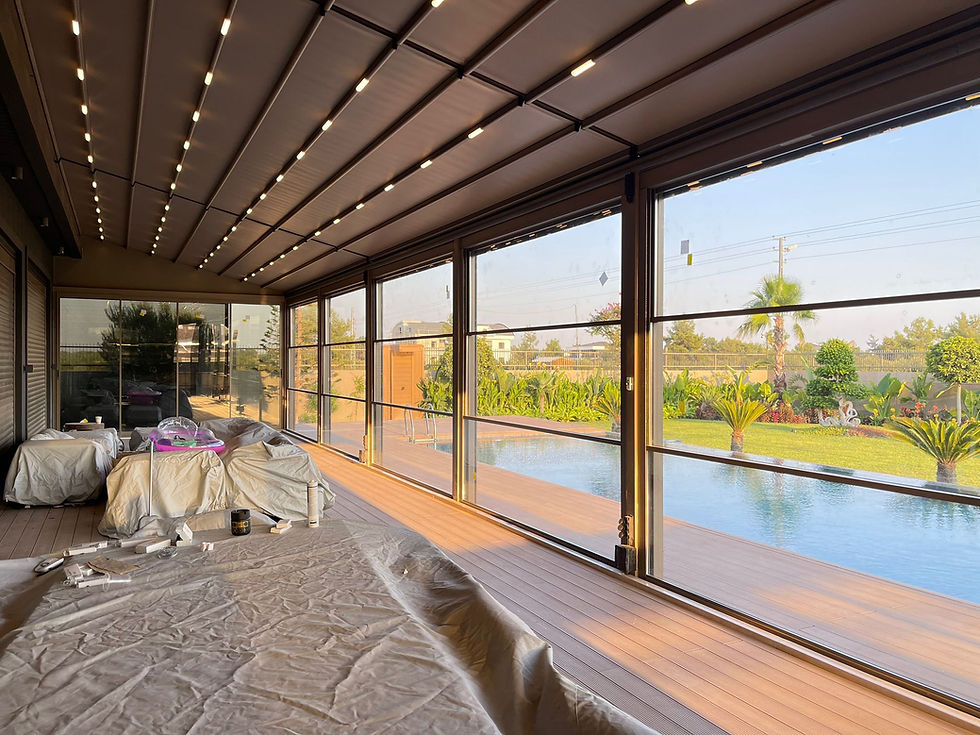
Because the framing is lighter and the panels are designed around flexibility rather than full thermal separation, the visual connection to the outdoors remains much cleaner. The structure feels less intrusive. Views stay uninterrupted. Openings feel wider and more natural.
For homeowners with panoramic yards, pool areas, waterfront properties, or garden-facing pergolas, this becomes one of the most valuable advantages. Sometimes the best outdoor spaces are the ones that still feel outdoors.
Climate Suitability Matters More Than Specification Sheets
Another important point often overlooked in product selection is actual climate behavior.
New Jersey experiences all four seasons, but many outdoor spaces are primarily used during moderate conditions: spring, summer evenings, and parts of fall. During these periods, non-insulated sliding systems perform exceptionally well because they support ventilation and adaptability instead of trapping heat unnecessarily.
Research from the U.S. Department of Energy has consistently emphasized the importance of natural ventilation and passive environmental strategies in reducing energy reliance and improving occupant comfort in transitional climates. In semi-outdoor spaces, operability can often contribute more to comfort than excessive enclosure alone.
That doesn’t mean insulated systems are unnecessary. It simply means that the right specification depends on the intended use of the space. A pergola attached to a backyard entertainment area has very different performance requirements from a fully conditioned indoor addition. Understanding that difference is where practical design begins.
The Psychological Effect of Openness
There’s also a less technical—but equally important—reason why non-insulated sliding glass works well. It changes how people perceive space.
Transparent systems with minimal interruption create visual continuity between interior and exterior areas. This often makes outdoor zones feel significantly larger and calmer. Natural light penetrates deeper. Sightlines remain uninterrupted. Landscaping becomes part of the architecture instead of something viewed separately from inside.
In many residential projects, homeowners initially focus on enclosure for protection. But after installation, what they often appreciate most is the feeling of openness that remains. The space feels lighter because the separation is lighter. This is especially true when combined with pergola systems that already regulate sunlight and airflow through rotating louvers, integrated shades, or adaptable roofing systems.
The result isn’t a completely indoor environment. It’s a controlled outdoor environment.
That difference is subtle, but important.
Cost Efficiency Without Sacrificing Experience
Another reason non-insulated systems are becoming more common is practical economics.
Because these systems require less material complexity than fully insulated alternatives, they can often provide significant functional value while keeping projects more financially balanced. This allows homeowners to allocate budget toward other meaningful upgrades:
Larger openings
Integrated lighting
Motorized shades
Better pergola systems
Outdoor kitchens
Higher-quality finishes
In other words, the project becomes more holistic instead of concentrating all resources into heavy enclosure systems that may not actually improve the experience proportionally. Good outdoor design is rarely about maximizing a single specification. It’s about balancing comfort, openness, usability, and environment together.
Why Outdoor Spaces Should Still Feel Connected to Nature
One of the most important lessons we’ve learned as a trusted pergola glass supplier in New Jersey is that successful outdoor spaces usually preserve some degree of environmental connection. Too much enclosure can unintentionally remove the very qualities that make outdoor living enjoyable in the first place:
Natural airflow
Seasonal atmosphere
Ambient sound
Light variation
Connection to landscaping
Non-insulated sliding glass systems help maintain that balance. They protect when necessary while still allowing the space to breathe. And in many cases, that restraint creates a better long-term experience than overbuilding the enclosure itself.

Final Thoughts from a Trusted Pergola Glass Supplier in New Jersey
Non-insulated sliding glass systems are often misunderstood because people evaluate them using indoor standards instead of outdoor realities. But for pergolas, patios, terraces, and semi-covered living spaces, they can offer a remarkably balanced solution: openness without excessive exposure, protection without visual heaviness, and flexibility without overcomplication.
As a trusted pergola glass supplier in New Jersey, we’ve found that the best outdoor spaces are rarely the ones most aggressively enclosed. More often, they’re the spaces that remain adaptable—responsive to weather, light, airflow, and how people actually want to live outdoors. If you’re exploring pergola glass systems and want practical guidance on whether insulated or non-insulated configurations make more sense for your space, feel free to reach out to Privlux on WhatsApp at 833 774 8589. We’re always happy to provide honest, experience-based recommendations tailored to how the space will truly be used.


Comments