_edited.png)
Glass Supplier in New York: Designing Outdoor Spaces for Spring and Year-Round Performance
- Privlux Inc.
- 20 hours ago
- 4 min read
There’s a specific challenge that appears every spring in outdoor design:
People want openness again—but they don’t want to lose protection. After winter, clients naturally begin looking for:
More airflow
More daylight
More connection to outdoor areas
But in places like New York and the Northeast, spring is unpredictable. A warm afternoon can quickly turn into wind, rain, or a sharp temperature drop by evening. That tension creates an important design question: How do you create a space that feels open during transitional seasons without sacrificing year-round usability?
As a glass supplier in New York, this is one of the most common problems we help clients think through—not by fully enclosing spaces, but by making them adaptable.
And increasingly, the answer is not one single system. It’s the combination of:
Pergolas
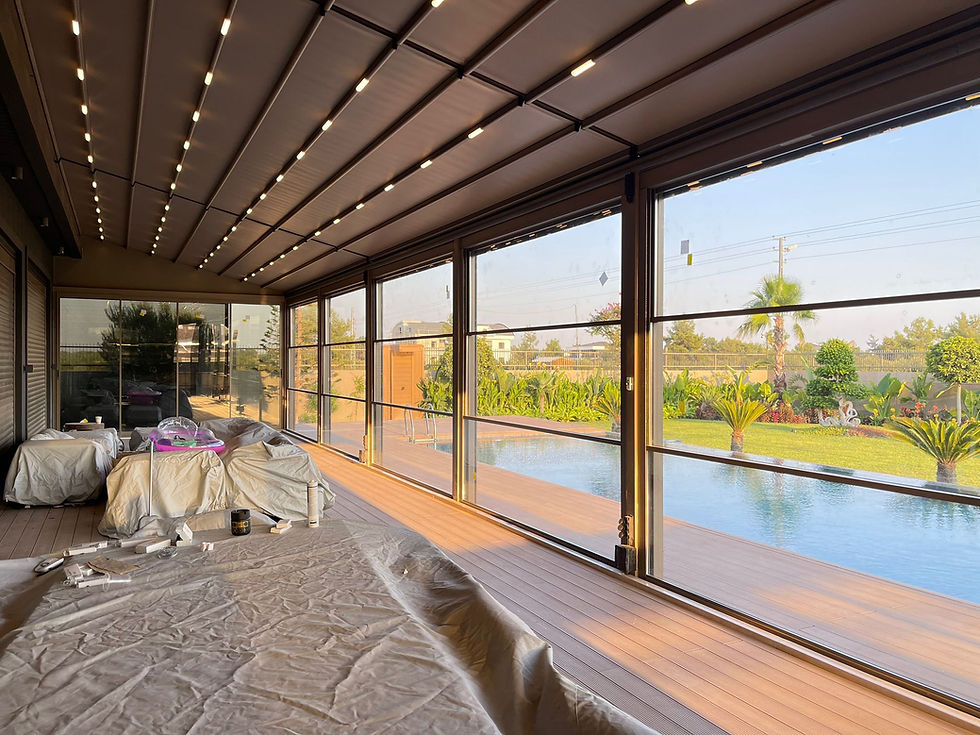
Guillotine (giliotina) glass systems
Vertical shades and zipscreens
Working together.
Why Spring Exposes Weaknesses in Outdoor Design
Many outdoor spaces perform well only under ideal conditions.
A patio may feel comfortable on a calm sunny day, but become unusable during:
Direct afternoon glare
Wind exposure
Sudden rain
Cooler evening temperatures
Spring tends to expose these limitations because conditions change constantly.
Research in adaptive comfort theory shows that people tolerate wider environmental variation when they can actively adjust their surroundings (ASHRAE Standard 55; Nicol & Humphreys). This idea matters more than many people realize. Comfort isn’t always about creating a perfectly controlled environment. Often, it’s about giving users the ability to respond to changing conditions. That’s where adaptable systems become valuable.
Pergolas: Controlling the Environment Overhead
Pergolas are often misunderstood as purely aesthetic structures. In reality, modern pergola systems—especially bioclimatic systems—function as environmental control layers.
Adjustable louvers help regulate:
Sun exposure
Airflow
Rain protection
Heat buildup
This becomes especially useful during spring because sunlight intensity changes significantly throughout the day. An open louver configuration may feel comfortable in the morning but require adjustment by midday.
As a glass supplier in New York, we’ve noticed clients becoming more aware that outdoor comfort depends less on permanent enclosure and more on environmental flexibility.
Pergolas create the first layer of that flexibility.

Why Guillotine Glass Systems Work Well in Transitional Seasons
One of the more effective systems for spring-oriented spaces is the guillotine (giliotina) glass system. Unlike fixed enclosures, guillotine systems allow large vertical openings while maintaining clear sightlines. That balance matters.
When fully closed:
They provide wind protection
Reduce exposure to colder air
Maintain visibility and daylight
When partially or fully opened:
Airflow improves significantly
The space feels connected to the outdoors again
Natural ventilation reduces reliance on conditioned air
This vertical operability creates a more gradual transition between indoors and outdoors compared to fully static systems. In practice, people often use these systems differently throughout the same day:
Closed during cooler mornings
Partially opened in the afternoon
Adjusted again in the evening depending on conditions
That responsiveness is what makes them particularly effective during spring.

Vertical Shades and Zipscreens: The Missing Layer
One of the most overlooked elements in outdoor environments is glare control.
Spring sunlight is lower and more directional compared to summer. This means side exposure becomes more noticeable, especially during mornings and late afternoons.
This is where:
Vertical shades
Zipscreens become important.
They help manage:
Solar glare
Heat gain
Privacy
Wind exposure
But unlike permanent walls, they preserve permeability. As a glass supplier in New York, we often see clients initially focus only on overhead systems like pergolas, then later realize side exposure affects comfort just as much. The most successful outdoor spaces usually rely on layered environmental control rather than a single solution.
Why Fully Enclosed Spaces Aren’t Always Better
There’s still a strong tendency in outdoor design to treat year-round usability as a problem solved only through enclosure. More glass. More insulation. More separation.
But that approach creates trade-offs:
Reduced airflow
Heavier visual presence
Less environmental responsiveness
Greater dependence on HVAC systems
Spring often reveals these limitations because the environment becomes pleasant enough that people actually want connection to the outdoors again. Spaces that cannot adapt start feeling overly sealed.
This is why many clients are now prioritizing systems that can shift between:
Open
Semi-protected
Fully protected
Instead of staying permanently fixed in one condition.
Adaptability Is Becoming More Important Than Permanence
One of the clearest trends we’ve seen as a glass supplier in New York is that clients increasingly value optionality. Not because they want complexity—but because climates themselves are becoming less predictable.
A well-designed outdoor system today needs to respond to:
Seasonal variation
Wind conditions
Temperature shifts
Different patterns of daily use
This is where combinations of:
Pergolas
Guillotine glass
Vertical shades work particularly well.
Together, they create spaces that remain usable across more conditions without losing openness.

Spring-Ready Outdoor Spaces with a Reliable Glass Supplier in New York
Spring tends to remind people that comfort isn’t only about protection. It’s also about responsiveness. The outdoor spaces that work best during transitional seasons are usually not the most enclosed. They are the ones that allow users to adjust airflow, shade, light, and exposure naturally throughout the day.
As a glass supplier in New York, we’ve found that systems like guillotine glass, pergolas, and vertical shades perform best when they work together—not to isolate people from the outdoors, but to make interaction with it more flexible.
Because year-round performance doesn’t always come from sealing a space completely.
Sometimes it comes from allowing it to adapt. If you’re planning an outdoor project and want practical guidance on adaptable glass and pergola systems for your space, you can reach us on WhatsApp at 833 774 8589 for expert advice or a quotation.


Comments