_edited.png)
How Custom Glass Enclosures Support Year Round Outdoor Living Through Autumn and Winter
- Privlux Inc.
- Nov 28, 2025
- 4 min read
Creating spaces that remain functional and comfortable outdoors is becoming increasingly relevant as homeowners look for ways to extend the usability of their patios, decks, and pergolas. Among the various enclosure methods available, custom-height fixed glass and sliding glass systems offer one of the most balanced and practical solutions for year round outdoor living—especially in climates where autumn winds and winter temperatures limit outdoor use.
This article examines the role of glass in seasonal usability from an environmental, structural, and comfort-based perspective. It draws on established principles in building physics, thermal comfort, and façade design to explain why glass systems are effective without overselling or embellishing their capabilities.

Understanding Seasonal Transitions: From Autumn Winds to Winter Cold
Autumn and winter introduce a combination of environmental stressors that influence comfort in semi-outdoor spaces. According to building science research and standards like ASHRAE 55 (Thermal Environmental Conditions for Human Occupancy), human comfort is shaped not only by temperature but also by air movement, humidity, and radiant heat exchange.
Glass does not generate heat on its own, but its physical properties make it a strong environmental modifier:
1. Reduction of Air Movement (Wind)
Glass is a rigid barrier, and even a partially enclosed structure with glass significantly reduces wind exposure. This is critical because wind dramatically increases convective heat loss from the body. In outdoor thermal studies, reducing wind speed is often one of the most effective ways to improve perceived temperature without additional heating.
2. Improved Radiant Comfort
Glass allows solar radiation to enter (depending on tint and thickness). On sunny days—common even in cold seasons—this creates modest but noticeable radiant warming of surfaces and air inside the pergola. Although not equivalent to insulation, the greenhouse-style effect contributes to maintaining a more stable microclimate.
3. Protection From Precipitation
Autumn and winter often bring slanted rain, frost, and occasional snow. A glass perimeter prevents moisture intrusion, which protects furnishings and maintains the usability of the space.
These environmental factors collectively support the idea of year round outdoor living, not by creating an indoor room, but by enhancing comfort through passive environmental control.
The Importance of Custom Glass Height
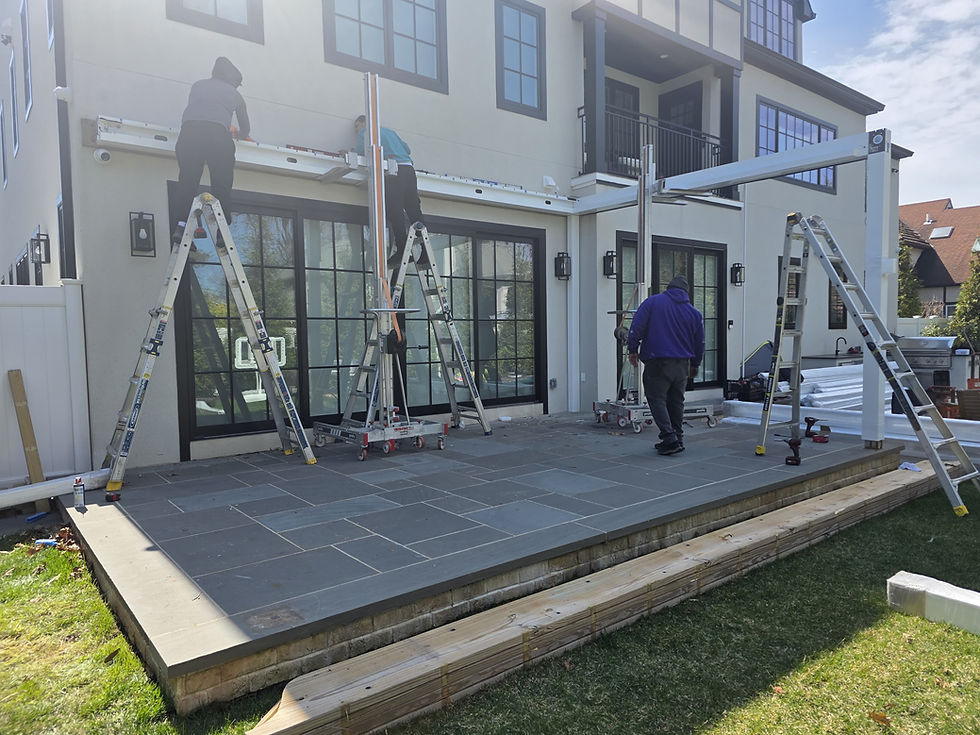
The project referenced in this post involved custom-height glass panels, tailored specifically to the homeowner’s pergola dimensions and functional needs. Custom height matters more than most people realize.
Why Height Matters
Wind pressure varies with height, and gaps at the top or bottom of a standard, non-custom panel can significantly reduce enclosure effectiveness. Research on wind flow around low-rise structures shows that turbulence intensifies as it interacts with edges and openings. Properly sized glass panels reduce these gaps and create a smoother wind profile around the enclosure.
Occupant-Level Comfort
Comfort is evaluated at the level where people sit and stand—typically between 2 to 6 feet above ground. If glass panels are too short, cold drafts can enter at this height even when the enclosure is partially closed. Custom-height glass avoids these issues and maintains a more consistent environment.
Aesthetics vs. Functionality
While aesthetics are secondary in this article, custom dimensions also ensure cleaner sightlines and better alignment with the pergola’s structure. This reduces rattling, improves safety, and avoids structural stress points.
Sliding Glass Systems: Flexibility for Autumn and Winter
Fixed glass provides continuous protection, but sliding glass systems introduce flexibility that supports year round outdoor living even during transitional seasons.
Ventilation Control
Autumn often brings fluctuating temperatures—cool mornings, mild afternoons, and cold evenings. A sliding system enables:
partial opening for natural ventilation
controlled airflow without full exposure
strategic cross-ventilation if multiple sides open
These principles align with passive ventilation guidelines found in architectural standards and environmental design literature.
Adapting to Microclimate Changes
Semi-outdoor spaces benefit from adaptability. One of the strengths of sliding glass is the ability to “tune” the pergola to changing conditions:
open sections on mild autumn days
close everything during windy winter nights
mix positions when sunlight is strong but temperatures are low
This adaptability is key to transforming an outdoor space into something suitable for year round outdoor living, without the rigidity of a fully enclosed sunroom or the exposure of an open pergola.
Thermal Behavior of Glass in Cold Seasons
Glass is not an insulator; even double-glazed units are primarily designed for energy-efficient interiors rather than outdoor structures. However, glass still plays a meaningful role in thermal comfort outdoors:
Solar Heat Gain
In winter, low-angle sunlight can enter through glass and warm interior surfaces. This is a well-documented phenomenon in passive-solar design.
Reduced Convective Loss
Blocking wind reduces the cooling effect of convection on skin and warm surfaces.
Support for Supplemental Heating
When used with radiant or infrared outdoor heaters, glass helps the space retain warmth long enough to create a comfortable environment.
These effects do not make the pergola "warm" by indoor standards, but they significantly widen the usable temperature range.

Material Considerations: Safety and Practicality
Glass used for outdoor structures must comply with safety standards. Tempered glass is routinely used in exterior applications because of its strength and fracture pattern, which minimizes injury risk if breakage occurs. (Reference: ANSI Z97.1 and CPSC 16 CFR 1201 – Safety Glazing Standards.)
For sliding systems, proper hardware—rollers, tracks, stoppers, and locking mechanisms—is essential for smooth operation and durability, especially when exposed to harsh seasonal elements.
Final Thoughts — Creating Year Round Outdoor Living With Smart Glass Design
Achieving year round outdoor living is not about turning an outdoor structure into an indoor room. Instead, it’s about using materials intelligently to adapt to seasonal changes. Custom-height glass and sliding glass systems support comfort in autumn and winter by reducing wind exposure, supporting passive solar gain, protecting against precipitation, and offering flexible ventilation control.
If you’re considering glass for your pergola or want expert guidance on custom sizing and configuration, call or WhatsApp us at 833-774-8589 for practical advice or a personalized quotation.


Comments