_edited.png)
Engineering Comfort Outdoors: A Technical Look from an Aluminum Pergola Supplier
- Privlux Inc.
- Nov 18, 2025
- 4 min read

Understanding Outdoor Comfort Beyond Aesthetics
In outdoor architecture, comfort is too often discussed as a feeling rather than a function. But in practice, comfort is the result of engineering — airflow, shading, drainage, lighting, and the way materials react to temperature and load.
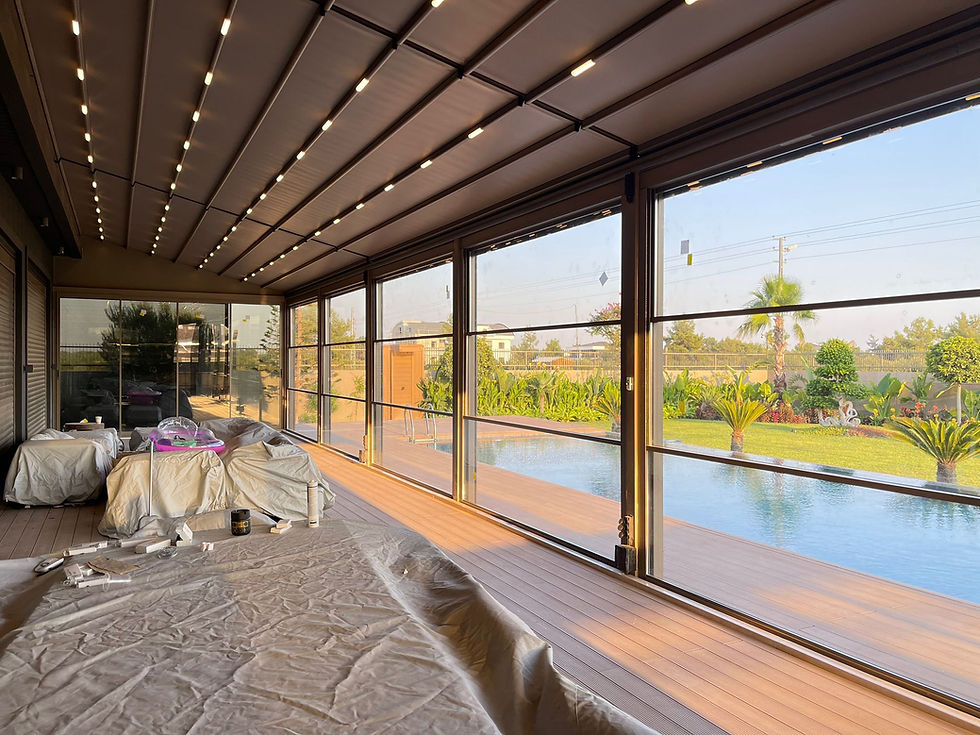
Our recent Visualize pergola installation offered a clear example of this principle in action. It wasn’t the aesthetics that defined the project’s success, but the precision behind each component — from how the aluminum frame maintained alignment under seasonal changes, to how drainage and lighting were integrated without disrupting usability.
As an aluminum pergola supplier, we’ve learned that the measure of comfort isn’t softness or color — it’s consistency. Structures that hold their geometry and systems that manage weather seamlessly create spaces that feel naturally livable.
1. The Structural Backbone: Stability as the Foundation of Comfort
The Visualize pergola’s three-module system was fully self-supporting — no external walls or tie-ins to the existing structure. This meant that structural precision was non-negotiable.
Aluminum was chosen not for its appearance but for its dimensional stability. Unlike wood, it does not expand or contract significantly with humidity or temperature changes. This stability keeps the louver mechanisms aligned, prevents binding of glass panels, and ensures that drainage channels remain consistent over time.
In engineering terms, aluminum’s coefficient of thermal expansion (about 23 × 10⁻⁶ /°C) is predictable and uniform, which allows for precise tolerances in moving parts such as louvers and shades. According to ASM International’s Materials Handbook, this predictability is one of the key reasons aluminum is used in high-performance architectural systems.
For the client, that translates to a simple outcome: a structure that feels “effortless” to operate, because it stays true in form no matter the season.
2. Managing Drainage: Where Engineering Meets Weather
Outdoor comfort is as much about dryness as it is about shelter. A pergola that leaks or pools water quickly becomes unusable.
The Visualize system integrates a concealed drainage network built directly into the blade channels and frame profiles. When the louvers close, they interlock and guide water toward perimeter gutters, which then channel it through internal posts. The geometry of these components is engineered to maintain flow even at shallow roof pitches — ensuring consistent drainage without visual clutter.
We had to account for this carefully because the patio’s existing parapet affected how water could discharge. By recalculating gutter slopes and outlet points, the system was adapted to drain efficiently while staying fully self-contained. This isn’t about “making it waterproof”; it’s about achieving controlled hydrology — directing water precisely so the system performs like a roof while retaining the openness of a pergola.
3. Custom Shade Dimensions: Solving for Real Site Conditions
One of the most practical challenges in this project was the parapet wall surrounding the client’s deck. Standard shade drops would have interfered with it, leaving gaps or wasted coverage. Instead, we designed custom-height vertical shades — shorter where the parapet already provided protection, and full-height for the main opening and entryway. This hybrid approach respected the existing architecture while preserving uniform visual lines.
This is an often-overlooked aspect of engineering in outdoor systems: fit is as important as strength. A pergola that perfectly fits the site’s geometry doesn’t just look integrated — it performs better. Air drafts are controlled more evenly, light filtering is balanced, and thermal comfort improves because the enclosure’s behavior is consistent.
4. Lighting Integration: Function Before Ambience
Lighting plays a measurable role in outdoor usability, especially during transitional seasons like autumn. For this project, we integrated LED line lights, spotlights, and step lights, all wired into concealed conduits within the pergola’s profiles.
The system design considered both illuminance and safety — step lights were placed for functional visibility (based on IES RP-33-14 outdoor walkway guidelines), while spotlights and LED lines maintained ambient levels between 50–150 lux, ideal for social comfort without glare. Beyond ambience, the lighting improves perceived warmth, a psychological aspect of comfort. Studies by the Lighting Research Center (RPI) show that warm-white lighting (2700–3000K) enhances users’ sense of enclosure and relaxation — especially important for outdoor living spaces transitioning into cooler months.
By integrating these elements into the aluminum profiles, we maintained a clean architectural finish while ensuring the system remains easy to service.
5. Engineering the Air: Natural Ventilation and Seasonal Use
Autumn is the ideal test for systems like this — cooler air, fluctuating humidity, and variable wind directions. The Visualize pergola’s rotating blades (up to 140°) allow natural convection to occur: warm air rises and escapes through open louvers while cooler air enters laterally.
This is a form of passive ventilation engineering — using geometry and movement instead of mechanical systems. The effect is subtle but measurable: reduced temperature buildup under sunlight and improved air freshness without drafts.
Even when the blades close during light rain, the sealed interlocking design prevents water ingress while maintaining air pressure equilibrium, reducing the chance of condensation buildup inside the structure.
6. Structure Meets Setting: The Science of Balance
The aluminum pergola’s minimal structure worked beautifully with the existing wooden flooring. This combination wasn’t accidental — it was an engineered pairing of materials with complementary properties. Wood adds tactile warmth and absorbs some surface vibration, while aluminum provides rigid, non-deforming support. Together, they create a space that feels grounded but not heavy — a practical lesson in material contrast for comfort.
As an aluminum pergola supplier, we see this as part of the evolving science of outdoor living: pairing structural predictability with sensory experience.

Final Thoughts: Engineering by a Seasoned Aluminum Pergola Supplier
Comfort outdoors isn’t created by decoration — it’s achieved by detail. Every adjustment, every calculation, and every tolerance defines how the space feels when you finally sit down in it.
The Visualize pergola project reminded us that the difference between a nice outdoor structure and a livable one lies in engineering decisions that aren’t always visible — shade height, water flow, material behavior, lighting angles. It’s a process of translating function into feeling — a craft we take seriously.
If you’re planning an outdoor living space and want expert input on aluminum pergola engineering, drainage design, or integrated lighting, our team can help you make those decisions early — where they matter most Call or message us on WhatsApp at 833 774 8589 for a consultation or quotation.


Comments